
History
The establishment of the ATV (Advisory body for Traditional Vessels) Foundation has quite a history behind it. In fact, it began with the entry into force of the Inland Navigation Act in 2009, which itself is an implementation of European Directive 2006/87/EC. According to Article 7 of the Inland Navigation Act, vessels (with a length of 20 m or more or a block volume of 100 m³ or more) navigating inland waterways must have a valid Inland Vessel Certificate on board. Since the expiry of the relevant transitional arrangement in December 2018, this also applies to pleasure craft. This means that pleasure craft of those dimensions are not permitted to sail without an Inland Vessel Certificate. Use as a houseboat or scrapping are often the only remaining options. However, a ‘traditional vessel’ can obtain an Inland Vessel Certificate with deviating regulations, allowing it to continue sailing with that vessel.
Initiative
Even before the expiration of the transitional arrangement, the Human Environment and Transport Inspectorate (ILT) gave a presentation to a delegation from the Federation of Maritime Heritage Netherlands (FVEN) in early 2018. In it, the ILT requested the FVEN to consider the establishment of an ATV foundation. This foundation would need to be recognized by the ILT as an “expert for traditional vessels ” authorized to provide advice on ‘traditional vessels’. As early as March 2018, the FVEN declared its willingness to take up this request. A working group was established, which presented its initial proposals in December 2018. After discussing these with the ILT, the final proposals followed in February 2019.
Commencement of activities
Following the notarial incorporation, the appointment of board members and experts, the adoption of the ‘Regulations for Implementation’, and recognition by the ILT, the ATV foundation was ready to launch in late 2020 / early 2021.
Even before the ILT’s recognition, the first vessel presented itself for assessment: the replica Witte Swaen. Subsequently, eight vessels were assessed in the period 2021–2022, six of which received the designation ‘traditional vessel’. In addition, many owners requested information about the activities of the ATV.
Stagnation
In 2023, a stagnation occurred that lasted until early 2025. Due to this stagnation, a number of vessels that had registered with the ATV were temporarily put ‘on hold’. The reason was not that the ATV could not assess the vessels, but rather that the follow-up procedure could not be carried out. This was because the ILT and the inspection bodies appeared to have insufficient experience. Since it concerned a new procedure, it would have to become clear in practice whether the procedure needed to be further tightened. The ILT wanted to be present during this process to learn from practice and, if necessary, adjust the working method based on the experiences.
In addition, a number of questions emerged during the 2021/2022 period as a result of the work:
• What is to be understood by ‘the chosen historical date’?
• What emission requirements must engines of ‘traditional vessels’ and ‘replicas’ meet?
• What is to be understood by ‘demonstration purposes’?
• Must all deviations from the standard regulations be included in the Inland Waterway Vessel Certificate?
• Which regulations apply when sailing with passengers on board ‘traditional vessels’?
Traditional ships cannot comply with modern regulations without destroying heritage.
Traditional ships should sail actively: no income no upkeep ‘no trips, no ships’
There will be numorous new old ships after the transition period:
replicas
restorations
spirit of tradition
change of function (e.g. from cargo to passenger ship)
Three problems currently:
- What is meant by “is operated for demonstration purposes in particular”?
Activities that keep knowledge, craftsmanship and seamanship alive, which are connected to the reconstruction, maintenance and the operation of vessels with traditional craft.
- The engine
- the vessel already has a valid inland navigation vessel certificate and keeps its certificate;
Transitional provisions are then applicable to the vessel, in particular those relating to Article 9.01(2) on emissions requirements.
- the vessel has no valid inland navigation vessel certificate, but the engine was already on board on the selected historical date;
Then, transitional provisions are not applicable to the vessel; however the engine can be accepted subject to a derogation in accordance with Article 24.01.
- the vessel has no valid inland navigation vessel certificate, and the engine was not on board on the selected historical date,
Then, transitional provisions are not applicable to the vessel. The vessel must comply with the current emissions requirements.
- Replicas of traditional vessels are always “new constructions” (no previous certificate) and the engines on board these vessels must always comply with current emission requirements.
- Passengers
Traditional craft must not create a competitive situation with passenger vessels. They can undertake activities relating to “demonstration purposes”, which must be included in the operations concept referred to in Article 24.02(2)(b).
In order to avoid unfair competition with passenger vessels, the recommendation could set a maximum number of persons apart from the crew. A solution similar to the one foreseen for passenger sailing vessels in Article 20.02 of ES-TRIN could be considered (i.e. “maximum permissible number of passengers not exceeding 𝐿WL”).
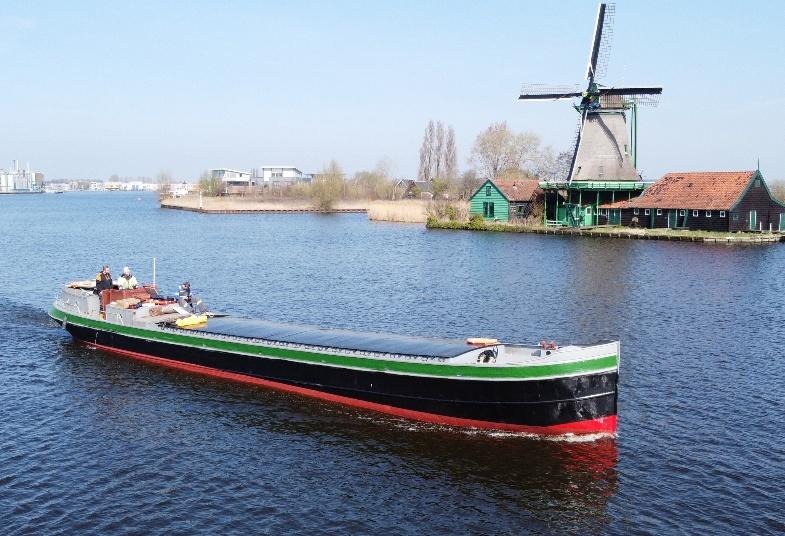
After twenty years the first traditional vessel is certificated thanks to all the efforts in the Netherlands.