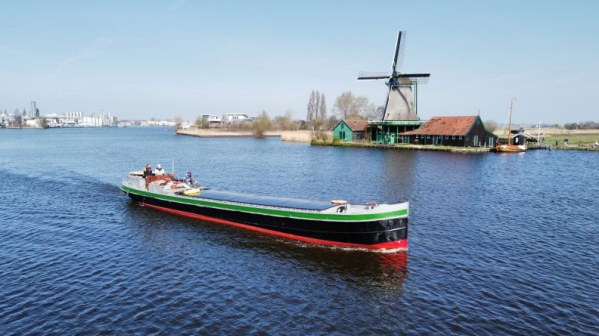
The 102-year-old Catharina can continue sailing thanks to the new inspection. This 22-meter-long “beurtmotor” (built in 1923) was the first vessel to receive in Netherlands the new “Traditional Vessel” certificate on Friday, November 14th. This is very good news for the EMH, after having lobbied for more than 20 years.
Back in 2004, EMH set up a special Inland Water Council (IWC) to draw special attention to traditional vessels in the European Directive. The IWC drew up a philosophy on how this could be achieved. During the revision of the directive in 2016 and the drafting of the text in Es-Trin (European Certification that establishes the Technical Requirements for Inland Waterway Vessels), traditional
vessels were included in Chapter 24. A condition was included that a heritage conservation authority with corresponding expertise in the field, or a traditional craft expert, must determine whether a vessel is a traditional vessel.
The Bureau Scheepvaart Certificering (BSC) explains that an exception in the Es-Trin regulations has been made for this category because such old vessels cannot meet the modern technical requirements for vessels over 20 meters.
This certificate allows Catharina to continue sailing legally as a traditional vessel, protecting its heritage value, instead of being immobilized for not complying with complete modern regulations.
Unchanged
The Catharina has remained virtually unchanged and still has its original Kromhout hot-bulb engine. The vessel used to sail between Langedijk, Amsterdam, and Zeeland, carrying sauerkraut barrels and vegetables; now, it is part of a museum at the auction in Broek op Langedijk and is privately owned. The certification process for the Catharina took several years because each component proved to be custom-made.
A major bottleneck was the old 22 hp engine: it is noisy, does not meet modern emissions standards, and reaches a speed that is actually too slow in some sailing areas. However, because the engine is of historical importance to the vessel, it was decided that the Catharina could still be certified and allowed to continue sailing.
Prior to the inspection, the recently established Advisory Body for Traditional Vessels (ATV) assesses a vessel’s eligibility; owners must then develop a user and safety concept. So far, eight vessels have registered with BSC. This initiative makes it possible to preserve culturally valuable inland vessels within a new legal and safety framework.
This news is a great achievement for the Dutch nautical heritage: such ancient vessels are not only a historical symbol, but ones that they can continue to do or have always done: sailing.